




Why 99% of Marketing Advice Is Complete Nonsense

Open any social media feed, and you’ll find yourself in an endless stream of marketing advice offered by self-proclaimed “experts”: “Use these 3 hashtags for a viral post!”, “Increase your sales by 500% with this one SEO trick!”, “Here’s an AI tool that will do your work for you!”. The internet is saturated with these promises that offer fast, easy, and guaranteed success. But let’s be honest: how many of them have actually worked for your business?
The truth is, the vast majority of the marketing advice we encounter daily is, at best, useless, and at worst, actively harmful. It creates false expectations, forces you to waste time and money on ineffective tactics, and ultimately leaves you with a sense of frustration and failure. This article is not another collection of tips. It’s an analysis of why so much marketing advice is nonsense and what the 1% that truly works looks like.
5 Reasons Why Most Marketing Advice Is Useless
The problem isn’t always the advice itself, but the context (or lack thereof) in which it’s given. Understanding these reasons is the first step to filtering out the noise.
1. The Complete Ignorance of Context
This is the single biggest and most fundamental problem. Marketing advice that works perfectly for Coca-Cola (a global brand with a massive budget) will be a disaster for a small, family-owned café. Advice that is effective for a B2B software company is completely useless for an online store selling handmade jewelry. There is no such thing as a universal marketing strategy. Your business, your audience, and your market are unique, and any generic marketing advice that ignores this is doomed to fail.
2. Tactics Without a Strategy
People love quick wins. That’s why tips like “Post three Reels a day” are so popular. This is a tactic. But if you don’t know who your audience is, what your core message is, or what your long-term business goal is (your strategy), then this tactic is the equivalent of driving an expensive car blindfolded. A huge amount of marketing advice focuses on these “shiny new objects” while completely forgetting the foundation.
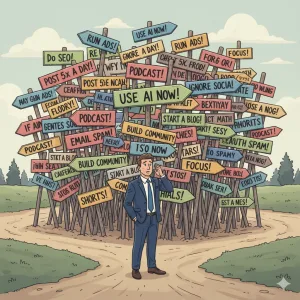
3. Survivorship Bias
We see the one influencer who became a massive success on TikTok. We read the story of the one startup that went viral. But we don’t see the thousands of others who did the exact same thing and failed. Marketing advice is often based on these exceptions, not the rules, which creates an unrealistic picture of success. Following the path of a lottery winner doesn’t guarantee you’ll win the lottery.
4. “Gurus” Who Are Selling a Dream
Many “marketing gurus” aren’t actually selling success; they’re selling the illusion of success. Their main product is their own course, book, or software. Therefore, their marketing advice is often oversimplified and overly optimistic to convince you that their “secret formula” is the only thing you need. They are selling you a product, and the advice is just their marketing funnel.
5. Outdated Information
The digital world changes at a breakneck speed. The Facebook algorithm that worked in 2023 might be obsolete by 2025. SEO optimization techniques are constantly evolving. A lot of the marketing advice floating around the internet is simply outdated and could end up harming your business more than helping it.

So, What’s the 1% That Actually Works?
If universal tricks don’t exist, then what’s the solution? The answer is to focus on fundamental principles. These are the timeless pieces of marketing advice that never get old.
1. Know Your Customer to an Obsessive Degree
Forget the algorithms. Study people. Who is your ideal customer? What are their deepest pains? What excites them? What language do they use? Every single marketing decision you make must flow from this knowledge.
2. Be Radically Different (or The Best)
In a saturated market, being average is the same as being invisible. Clearly define your Unique Value Proposition (UVP). What makes you stand out? Are you the cheapest? The most luxurious? Do you offer the best customer service? If you don’t have an answer to this question, your customers won’t have a reason to choose you. The process of brand creation is about defining this difference.
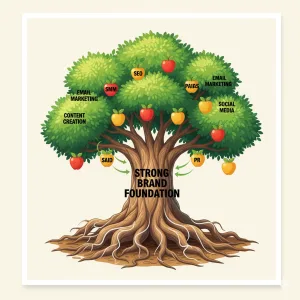
3. Build a Brand, Not Just a Sales Funnel
A sales funnel is important, but it’s a tactic. A brand is a long-term asset. A brand is what people think and feel about you. Create a story, build an emotional connection. A strong brand is your best defense against competitors. Esteemed marketer Seth Godin speaks extensively about this on his daily blog.
4. Test, Test, and Test Again
No “guru” knows your business and your audience better than you do. Don’t take any advice blindly. Turn every idea, whether it’s an ad copy or a post design, into a hypothesis and test it. Measure the results (clicks, conversions) and make decisions based on data, not on opinions.
5. Be Annoyingly Consistent
This is the most boring but most important piece of marketing advice. Success comes not from one viral post, but from hundreds of consistent, valuable posts over time. Not from one genius ad, but from repeating the right message for months. Consistency builds trust, and trust drives sales.
Conclusion
Stop searching for the next “miracle” hack. 99% of marketing advice is nonsense because it’s stripped of your unique business context. The real secret is within you and your customers. Go deep on your audience, create genuine value, be consistent, and trust data, not “experts.” That is the 1% that has always worked and will always work.
If you need a partner to help you develop a data-driven strategy tailored to your business—not just generic advice—our marketing agency is ready to help.